Saturday, September 5, 2015

FREE eBOOK: Middle Ground Prepping – A Sensible Approach

Hayman at A Blog for the Peninsula CERT Community - 1 week ago


Middle Ground Prepping – A Sensible Approach eBook Available September 2nd! Jim Serre is proud to announce the launch of his new eBook. Learn how middle ground prepping can get you prepared without taking over your life. Somewhere in between … Continue reading original post →


First impressions:
I have read the introduction and glanced through the remainder with the intention for a more thorough read soon.  This looks like an ideal introduction to disaster preparedness which you could give to anyone who would like to see just what this "prepping stuff" is all about.  It even addresses the over-dramatized TV shows featuring wild, edge-of-reality preppers and shows how those stories were sensationalized.  The remainder of the book seems to cover historical disasters and moves into some basic preparations that are good for anyone to make.  More later...

Where to get this book: 
Search Amazon.com for "Middle Ground Prepping" and you will find that the Kindle version of this book is still free. .  If you would like the paperback version, it is $11.99.

Tuesday, December 25, 2012

A Different Look at CERT training - Levels-based training


Hi CERT members!

I recently had the privilege to chat with one of the leaders of a Northern California CERT program.  He introduced me to their "Levels" training.  In their program once you finish the Basic CERT training, you are welcomed to the team and he reported that many people decide to stop at that level.

However, they also have advanced training for those who wish to become more proficient in a wide variety of disaster operations.  There also is some sort of recognition for those who reach those higher levels of readiness but I didn't get any specifics on that aspect of the program.

He pointed me to their website for specifics on the advanced training and I was very impressed so I would like to share some excerpts of what I found with you.

Level One
This is the basic CERT training that is a part of all CERT programs and ends with a disaster simulation.

Level Two
Requires the completion of 2 American Red Cross (ARC) classes - Disaster Services Overview and Shelter Operations (a background check may be required).  In addition, the National Incident Management System IS-100, 200, 700 and 800b courses are required.

Level Three
Requires the completion of the Emergency Medical Responder course (either ARC Emergency Response or ASHI Emergency Medical Responder) and CPR for the Professional Rescuer.  Licensing as an EMT or health care professional also qualifies you for this level.

Additional Advanced Training is also offered (some of which are offered in the San Diego CERT program).

An 8 hour module on Wild-land Fire/Urban Interface
A 4 hour course on Hazardous Materials Awareness
A 4 hour course in Traffic Control
A 10 hour course on Flooding and Swift Water Awareness
A state-wide, CERT Instructor Training program
Other Training
Many other topics such as map reading and navigation, Pet First Aid, Helicopter Safety and Auto Extrication are also offered for their CERT Level 2 and 3 members.  They have also partnered with other programs for cross-training of CERT members in areas such as Urban Search & Rescue (US&R), the Chaplaincy Program and the Animal Response Team.

As I stated earlier, I was very impressed with their "Levels" program.  It would be nice to see something like that available for CERT programs everywhere.

Terry Walters
Mira Mesa CERT

Wednesday, December 19, 2012

Food Storage Shelf Life

Food Storage Shelf Life:
Okay, most of us should have food stored away as part of our emergency preparedness.  Keep in mind that only specially prepared products like camping meals, MREs and true emergency rations have multi-year expiration dates.  That means those cans of beans,  boxes of oatmeal and jars of peanut butter all have varying shelf lives.
This website lists expected shelf life for a wide variety of goods and is a great reference for folks maintaining their supplies.

shelf life


Saturday, November 17, 2012

Fire Station App for iOS devices


Fire Station App for iPhone/iPad locates and maps fire stations in CA! It's available in the App Store. Like us on FB at www.facebook.com/FireStationApp
Available on the App Store · http://www.firestationapp.com

Solar Power for Emergency Preparedness

Solar Power for Emergency Preparedness:
Being CERT-trained, we all have a better appreciation for being prepared for the unexpected.  We all know to store food and water and medical supplies to get us thru the first few critical days following a disaster, but have you thought about storing electricity?
As we have seen in the news recently, it is often the extended duration of power outages that can cause the most distress and inconvenience.  Some folks have generators, but it’s not the most efficient use of potentially scarce gasoline to burn fuel to run a few lamps or charge a phone.
Those that know me know are never surprised to find that I’ve added another  new technology/gadget/tool to my inventory.  Allow me to introduce Goal Zero. I have been keeping an eye on portable solar technology for some time, watching it mature and become more affordable.  Goal Zero is a Utah-based company that truly embraces the ethos of living off the grid but still using all our personal technology.
  This is the Lighthouse lantern.  It has a built-in battery that can be charged by AC adapter, car 12V, hand crank, or solar panel.  Here it is shown recharging from the Nomad 7 portable solar panel.
Besides providing six hours of light with a fully charged battery, the Lighthouse has a USB plug (how cool is that!)  The battery is, as shown here, strong enough to charge an iPhone.
Here is the Nomad 7 solar panel.  This panel generates 7W of power and also has its own USB plug that you can plug your smartphone into and charge directly from the sun.  This panel requires direct sun for best performance.
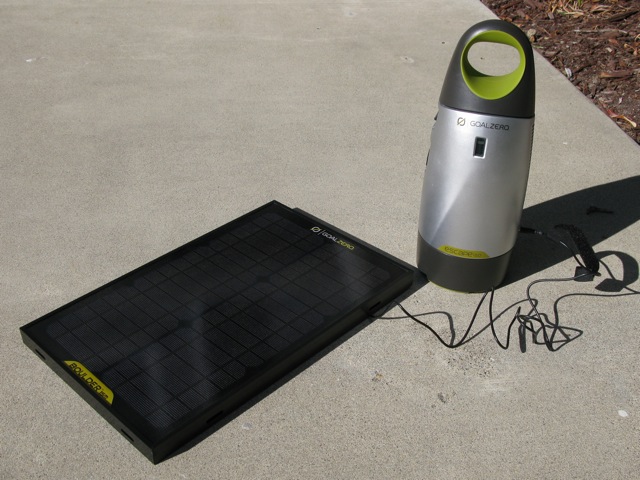
Here is the Goal Zero Escape 150 kit.  The Escape 150 is the tall unit that looks like a Thermos bottle.  It contains a large lead-acid battery (150 W-hrs) that can be charged from an AC adapter, car 12V or from the sun.  The panel generates 15W of power, uses more advanced solar cells and is completely weatherproof.  I have been using the panel indoors to keep the Escape 150 fully charged and it charges in a wider range of lighting conditions than the Nomad 7.
Here you can see what the Escape 150 is great at doing, providing you a 110V electrical outlet wherever you need it!  Besides the 110 AC outlet, there is also a USB plug.  Here you see that I am charging my iPad using the AC adapter.  This unit can also power a laptop too.
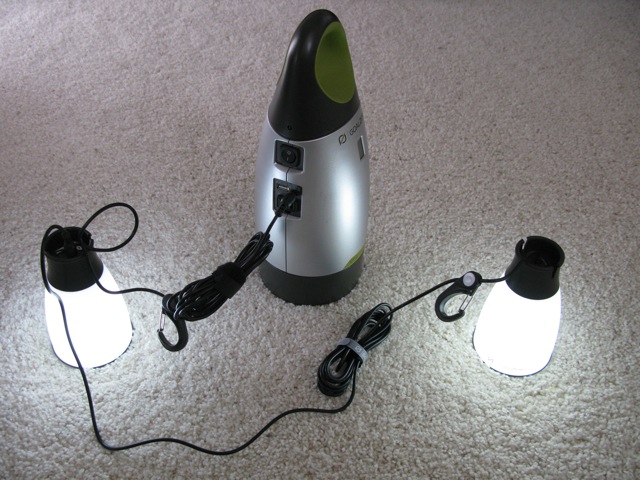
In this photo, I have some Goal Zero LED lanterns plugged into the Escape 150.  These lanterns put out a lot of light and you can daisy chain up to eight lights.
As you can see, these items can be useful in so many ways outside of a disaster scenario.  Goal Zero items can be found at Costco (only when they have a show), REI and Amazon.

Saturday, September 8, 2012

Emergency Preparedness Includes Signals to Get You Rescued

Emergency Preparedness Includes Signals to Get You Rescued:
I’m often asked, what is the best way to signal for help? Your emergency preparedness plan must include various methods of attracting rescuers in different situations.
If you are lost or find yourself in need of rescue in the outdoors, and you don’t believe rescuers to be nearby, you first need to move to the largest available clear and flat area on the highest possible terrain that you can access. In daylight hours you can:
1. Use your available gear to create a signal on the ground; generally these could be unnatural geometric patterns such as straight lines, circles, triangles, etc. This could be done with reflective thermal blankets or a bright orange tube tent, using rocks to keep them in place. You could also use available tools or sticks to clear away weeds to create similar patterns on the ground that would be visible form the air. Such techniques may also help you avoid starting a wildfire.
Read the rest of this article here
This information has been provided for our CERT group’s use courtesy of GetReadyGear

Sunday, August 12, 2012

Active Shooter Preparedness Training & Tips

Active Shooter Preparedness Training & Tips:
It has been so tragic to read about the recent shooter events in Colorado and Wisconsin, so it should be no surprise that there is preparedness materials and training available to help you should you ever find yourself involved in such a situation.
The Department of Homeland Security document “Active Shooter, How to Respond”  was first compiled in 2008 for retailers and mall operators. However, the guidelines are applicable to offices and any public gathering place.  A companion pocket guide is also available.  There is also an online FEMA training on this topic: “IS-907 – Active Shooter Response
Let us hope that none of us would ever have to deal with such a event, but now we know what resources exist if you feel the need to be better prepared.

Saturday, August 4, 2012

Emergency Preparedness : Stocking Disaster Survival Supplies

Emergency Preparedness : Stocking Disaster Survival Supplies:
When stocking emergency supplies, it's important to consider how these supplies are going to have to be stored. Discover why it's important to use non-perishable food items in a survival kit with help from a street firefighter in this free video on emergency preparedness.

Expert: Joe Bruni
Contact: firestop.staylow@verizon.net
Bio: Captain Joe Bruni has over three decades of experience as a street firefighter and company officer.
Filmmaker: Christopher Rokosz
Views:
14256
38
ratings
Time:
01:55
More in
Howto & Style

Tuesday, July 31, 2012

Is Your Family Ready for Fire Season?


Fire season is fast approaching and there are a lot of good ideas on planning for evacuations in case you home is threatened.  The wildfires here in San Diego have taught us a valuable lesson, you don't have to live out in the backwoods to have your house threatened.  Fires can strike anywhere and any time so it is important to have an evacuation plan ready. There really are no right or wrong evacuation plans - except for not having any plan at all.

A real-life example of someone not having a plan for evacuation was shown on TV during the 2003 wildfire here in San Diego.  The fire had already burned down dozens of homes in the Scripps Ranch suburb when a local camera crew showed a lady leaving her house in an area that had just been ordered to evacuate.  She was walking to her car carrying a potted fern.  She looked distraught and her car looked otherwise empty as she got in.  I remember thinking, she's in shock because of the shear impact of the possibility of losing her home.  She had just grabbed the first thing she saw - a potted fern.  Who knows how much she lost to this massive wildfire.  The image of her getting into her car and driving away with her fern stayed with me for a long time.  Surely there had to be some things far more precious to her and which she now sorely misses.  If she'd only had a evacuation plan so she didn't have to think about what to take during the middle of the emergency.

Not wanting to end up in the same situation in a future emergency, I started looking around at various evacuation plans for my family such as assigning members of the household to get specific items or having containers marked with things to put in them or already filled with supplies.  Each of these plans will work but also have drawbacks for my situation.  If someone isn't home for instance, who picks up the items they should have gotten?  Finding storage space or rotating supplies are also issues I would rather not have to address.  I finally settled on a concept I call a "Bug-Out List".  It has some major benefits compared to the other plans.  It doesn't make any assumptions on who is at home or how much time you have to evacuate.  It doesn't matter if you have 3 minutes, 3 hours or even 3 days to evacuate.  It mostly requires you to sit down with your family and create a list of things to get in order of importance.

To begin building your own Bug-Out list,  we should start by thinking about a worst case scenario.  Let's assume that you are in bed asleep.  When you wake there are no lights or power and it's the middle of a dark, overcast night.  A big earthquake could cause something like this and the last thing you want to be doing is stumbling around in the dark.

The first thing you should be able to grab right at your bedside is a good flashlight.  Your cell phone can also double as a flashlight in a pinch but three or four D-cell flashlight would work a lot better.  Next, hard-soled shoes right at your bedside in case there is glass or other sharp objects on the floor or outside.  Quick fact: did you know that cuts to feet by glass was the most common injury in the 1992 LA earthquake?

So far we're only talking a minute or two getting our feet protected and being able to see.  Next, you probably want to grab your clothes and jackets.  Just grab them - don't stop to put them on if it's dangerous inside but we will need them if we have to go outside.  Even the warmest evenings can quickly get miserable if we're outside in our pajamas.

Ok, here's our list so far which assumes we only had 3 minutes to evacuate because of an immediate disaster such as fire or earthquake.

1. Flashlight
2. Shoes
3. Clothes
4. Jackets

Now let's change the evacuation time to 30 minutes and add to our list more items in order of importance.   Once we've escaped the immediate danger, we now need to concern ourselves with any injuries you have and staying healthy.  So to my list I add the first aid supplies I have ready to go and all the prescription medicines my family will need.  Hopefully, enough medicine to last three days or more because in a major event, we may not see help for 72 hours or more.

5. First Aid Kit
6. Prescription Drugs

We now have to consider the survival triangle: Water, Food and Shelter.  Initially, shelter and water are going to be the most important of the three sides, food will become important later on.  Shelter from the elements is usually first but if you are in a very hot climate water could well be of prime importance.  So the next things on our list  should address shelter, water and then food.  First, personal shelter in the form of blankets, and to that we will add bath towels.  Towels can be used as an improvised hoodies if you need to keep warm, in additional to their more classic uses.  You may also want to have space blankets because they are waterproof in addition to being warm.  Next, shelter!  My family has a lot of camping gear which will shelter us if we cannot return to our house and there aren't any other shelter options available.  Your family may have a travel trailer or motor home or even a storage shed out back might work with a little preparation.

So here are my additions to my list.

7. Blankets
8. Towels
9. Camping Tents
10. Camp Heaters
11. Camp Stove
12. Matches
13. Firestarters
14 Water
15 Non- perishable foods: canned goods, dried pasta and beans.
16.Pet food

Food, water and shelter have all now been addressed.  Probably within the 30 minutes you had available to evacuate too!

With hours or even days of time available, you could get some less obvious items onto your "Bug-out List" such as a camp toilet, toilet paper and sanitary items to go with it which you might need if help is delayed.  Radios, batteries, laptop computers and computer backup drives will be useful to get information and to be able to recover financial and property data afterwards.  My list has almost 200 items goes as far as our photo albums, stamp collections, artwork and musical instruments.  For instance, I can load the piano and TV's and artwork into the trailer if there's a day or more time to evacuate.

In conclusion, you can make the list cover just a few items or virtually your entire house depending on how far you wish to take it.  But if something happens, all you have to do is tell whoever is there at the house to keep going down the list until you are told you have to evacuate.  That way you won't be grabbing a potted fern in desperation like that lady.  You will be certain that you gotten everything you had time to get and that you didn't leave anything important behind.

I welcome your comments and any evacuation plans you would like to share with us.

TJ Walters
Thursday, July 12, 2012

FEMA Liability Guide

Dear CERTers, The Community Emergency Response Team (CERT) Program at FEMA is pleased to announce publication of the new CERT Liability Guide, now available for download on the Supplemental Information page of the National CERT website at http://www.citizencorps.gov/cert/downloads/pdf/CERT_Liability_Guide.pdf. CERT programs across the nation support post-disaster response and help ensure that CERT efforts are as safe and effective as possible. CERT advocates have understood that program activities can create risk and adverse consequences; however, perceptions about liability may become a larger barrier to CERT formation, activities and partnerships than is justified by reality. The purpose of this Guide is to offer information and suggested techniques to help local CERT programs overcome this barrier. The audience includes local programs, their sponsoring government agencies and legal advisors, and CERT members themselves. The new CERT Liability Guide presents the benefits of risk management for CERT programs, including building confidence and a positive public image for the program, reducing the cost of insurance and avoiding other costs, helping to preserve a local program’s investment in its members, and increasing overall participation in CERT. The Guide also presents five steps to effective risk management for local CERT programs: 1) Securing leadership support; 2) Collecting information to identify liability exposure; 3) Identifying and analyzing risks; 4) Adopting strategies to manage risk; and, 5) Adopting standard practices for ongoing risk management. Specific activities and considerations are described under each of the five steps. Local CERT programs that consistently follow the process described in the new Guide can benefit themselves, their sponsors, their members, and the community. Please download and review the CERT Liability Guide. And please let CERT practitioners and advocates around the country know your thoughts about the new Guide or any aspect of CERT at the CERT Online Forum. Share your ideas, suggestions and comments at http://community.fema.gov. Thank you! Sincerely, National CERT Program Federal Emergency Management Agency ________________________________________